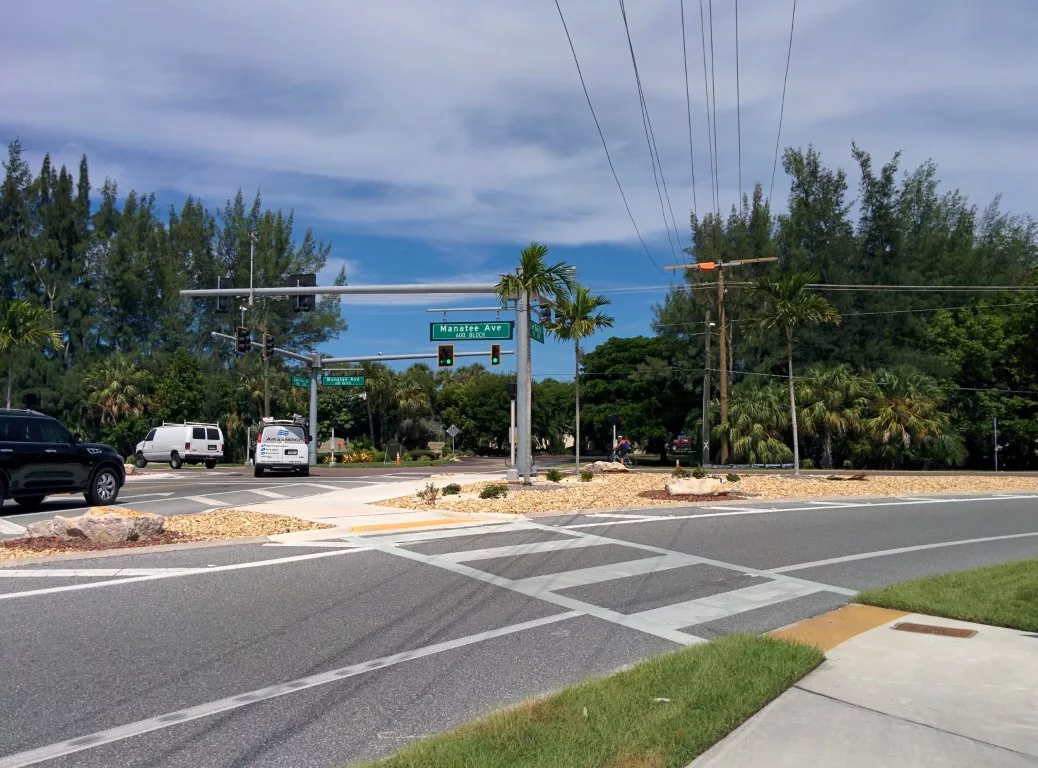
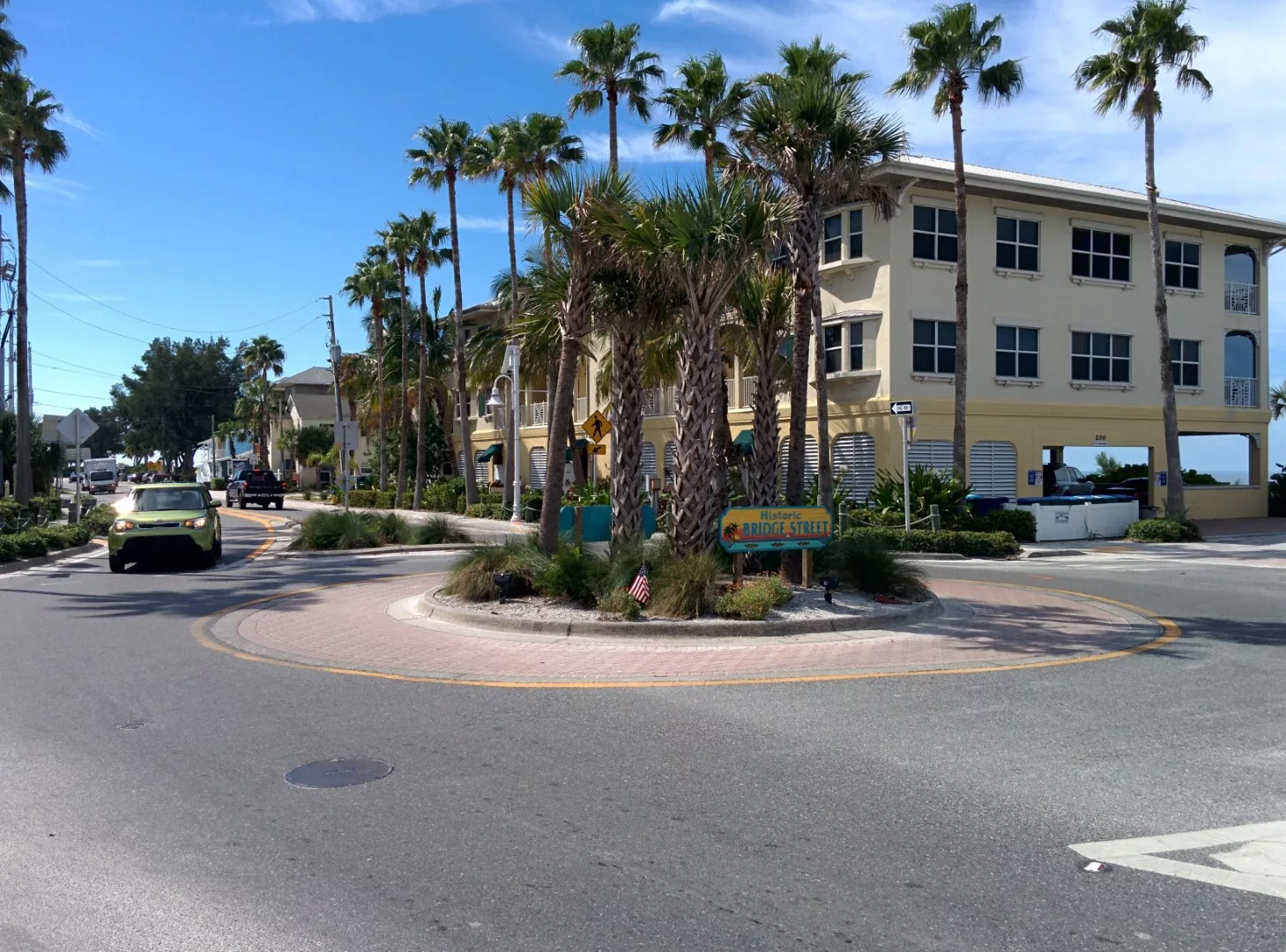
Effective March 20, 2026, Manatee County replaced its 2015 transportation review framework with updated Traffic Study Guidelines. The revised standards transition development review from traditional Level of Service (LOS) capacity analysis to a comprehensive operational, safety, and multimodal framework.
What’s New in the 2026 Manatee County Traffic Study Guidelines?
The 2026 guidelines introduce structural changes to how land development applications—ranging from Future Land Use Map (FLUM) amendments to Final Site Plans—are assessed. Below are the key pillars of the new requirements:
1. New Study Classifications
Studies are categorized into four distinct review tracks based on application scope:
- Comprehensive Plan Amendment Traffic Study (CPA-TS): Required for legislative Future Land Use Map amendments to evaluate short-term (5-year) and long-term (20-year) horizon impacts on system capacity.
- Multimodal Site Access and Safety Analysis (MSASA): Required for quasi-judicial requests such as General Development Plans (GDP), Rezonings (Z), Preliminary Site Plans with Rezone (PSP-Z), and Special Permits (SP).
- Trip Reservation Report (TRR) and Operational Analysis (OA): The most basic study type. It is required to contain PM peak hour trips and dedicated site-related analysis focusing on driveway location, spacing, turn lane warrants, queuing, and intersection control.
2. Standardized Trip Thresholds
To streamline lower-impact projects, the updated rules establish clear waiver and exemption thresholds based on Institute of Transportation Engineers (ITE) standards:
- Traffic Study Waiver: A waiver can be granted if a Trip Generation Comparison demonstrates that the proposed use generates fewer than 100 net PM peak hour trips compared to existing allowable or approved uses.
- De Minimis Threshold: Projects generating fewer than 50 gross PM peak hour trips or fewer than 300 gross daily trips qualify as De Minimis.
- Large Projects: Developments with 800 or more residential units (or commercial equivalent in PM peak trips) trigger full system significance testing and multimodal impact mitigations.
3. Multimodal & Transit Integration (MSASA)
The MSASA now requires explicit planning and design accommodations for non-motorized users:
- Pedestrian & Bicycle Facilities: Direct, accessible pedestrian connections from site entrances to public sidewalks are mandatory, along with site frontage sidewalks, shared-use paths, and sheltered bicycle parking.
- Quantitative Non-Motorized Analysis: Projects generating more than 20 non-motorized peak hour trips must perform a route directness ratio and network connectivity analysis.
- Transit Access: Developments along active Manatee County Area Transit (MCAT) routes must incorporate transit infrastructure based on daily trip thresholds:
- Over 500 daily trips: ADA-accessible concrete pad for shelters.
- Over 1,000 daily trips: Concrete pad and basic bus shelter.
- Over 2,000 daily trips: Full bus turn-out bay with shelter.
4. Mandatory 5-Year Safety Evaluation
Every MSASA must include a 5-year historical traffic crash analysis (evaluating both motorized and non-motorized incidents) across the study area. Any location with a fatal or severe injury crash within the past 5 years triggers an intersection control evaluation to determine whether a roundabout or signal is warranted.
5. Regional Travel Demand Modeling
For developments generating more than 100 PM peak hour gross trips, or for any Comprehensive Plan Amendment, trip distribution must be modeled using the FDOT District 1 Regional Planning Model (D1RPM).
6. Neighborhood Local Street Impact Evaluations
When a proposed development routes site traffic onto a local residential street, the guidelines require a local street traffic calming and safety evaluation if:
- Total local street volume plus project traffic exceeds 1,000 daily trips, or
- Project traffic adds more than 200 daily trips to the local street.
Key Takeaways
| Feature | 2015 Guidelines | 2026 Guidelines |
|---|---|---|
| Primary Focus | Roadway Concurrency & Level of Service (LOS) | Multimodal Access, Safety, & Operational Analysis |
| Study Types | TIS and TIA | CPA-TS, MSASA, TRR, and OA |
| Trip Distribution | Select Zone / Model / Counts | Mandatory use of D1RPM if >100 PM Peak Trips |
| Safety Analysis | General access review | Mandatory 5-Year crash data review |
| Multimodal Requirements | Basic pedestrian review | Route Directness & MCAT Transit Thresholds |
| Submission Portal | Physical /CD Submittals | Accela |
Digital Delivery
To streamline reviews and maintain inter-departmental consistency between Transportation Planning and Traffic Engineering, Manatee County has shifted all methodology submissions and study reviews to their digital Accela portal.
- Pre-Application & Methodology Submission: Prior to formal application completeness routing, applicants must submit a detailed Methodology Statement via Accela.
- Methodology Meeting: County staff will conduct a methodology review within 10 working days to reach consensus on study parameters, trip distribution, crash data ranges, and software tools.
- Engineering Certification: All traffic studies, reports, and methodology letters must be signed and sealed by a registered Professional Engineer (PE) in the State of Florida.
Let us support you
Navigating Manatee County’s updated traffic study guidelines requires an approach that balances vehicle capacity with multimodal safety and site design. Barrios Consulting Group can guide your project through this new process efficiently and effectively.